
Conservative Commentary
"the blogger whose youthful effusions have won him bookmarks all over Whitehall ... horribly compelling" - The Guardian
|
|
Conservative Commentary "the blogger whose youthful effusions have won him bookmarks all over Whitehall ... horribly compelling" - The Guardian |
|
|
Saturday, January 31, 2004
Still biased, still unfair, still in need of huge reform
Below I mourned that Hutton had not killed two birds with one stone. I may have been too hasty. Three times as many people trust the BBC to tell the truth than trust the government, despite Lord Hutton's damning judgment, an exclusive poll by ICM for the Guardian shows. If these bastions of the left cannot sort themselves out, something will have to rise to fill that vacuum and offer an alternative - something better. If Margaret Thatcher proved anything, it's that once the much-abused if patient majority of the British people finally becomes tired of being alternately shoved around and ignored, nothing can get in the way of the backlash - not the BBC, not the Labour Party, not the criminals' advocates or the trade unions, not the PC lobbies or the statist wastrels. Let us hope this marks the beginning of the beginning of that process. As for the BBC: with two scalps at the very top claimed, things are certainly looking up. Electric Review goes as far as to say that the pro-government, anti-BBC angle of Hutton was actually preferable to the reverse, because the BBC and not Labour is the Tory Party's greatest enemy. And let no conservative doubt that the BBC must be changed radically. The case for this would be strong even if it were politically neutral. Its current method of funding has in recent years become an embarrassing anachronism as hundreds of channels have become accessible to television viewers, but anyone who wishes to watch them must pay a £116 a year poll tax to fund a small handful. But the case for scrapping it ought to be unanswerable for anyone with a basically conservative view of life who cares that his ideas are represented fairly. Let it be explained once again to those who maintain their scepticism what is meant when the BBC is described as biased. What is not usually meant is that the corporation regularly shows a direct bias for or against a particular political party. There have been occasional moments when this was the case - the extremely negative coverage of the Tory victory in the 2003 Local Elections, or the picture of Mussolini beside Iain Duncan Smith in one news piece about birthrates - stands out. But in general, I would myself say that the BBC is basically fair in the way it deals with the parties. What is not meant is that the BBC has a conscious agenda of setting out to defend a left-liberal consensus. I say with even more confidence that this is not the case. What is meant by accusations of BBC bias is that the institution as a whole is dominated by and infected with a culture that views as sensible, moderate and normal the ideas of Roy Jenkins and Polly Toynbee and as suspect and peculiar the ideas of Michael Howard and Charles Moore. It's not that the people who set the agenda on the BBC have in their minds a deliberate aim of promoting this sort of thinking: it's that recruitment always being from the infamous jobs section of the Guardian they tend to be drawn from all the same sections of society, the same opinions of the world. The result is a group of people generally so closeted as to be unable to understand any good reason for disputing the tenets of their ideas. These people have rarely had to fear their house being broken into in the middle of the night: they are more worried about the burglars being jailed. They've never been to a party where it would be anything but social death to worry about the new age travellers in the park near one's home. They've never questioned why the euro is a good thing; it's blindingly obvious that anyone opposed is a xenophobic little Englander. And every day they read columns and articles assuring them that those who are different are simply less educated or cultivated than they are, that they give in to base prejudice and bigotry where their betters always have a liberal platitude at the ready. Janet Daley has encountered this culture at its most blatant when trying to engage typical BBC employees in political discussion. What is most disturbing about encounters with BBC current affairs people is not that one has disagreements with them, but that they regard their own quite narrow frame of reference as the only rational one. And when one understands how these closeted types think, their whole attitude is all the more explicable. When the Beeb's Brussels correspondent warned of a "Referendum Danger for EU" that could leave in pieces "two years of painstaking work by Valery Giscard d'Estaing" - heaven forbid! - it wasn't a conscious effort to promote the Europhile cause. Nor was this true of Stephen Sackur's report on the Swedish euro referendum, quoting Romano Prodi that "The people who know the European Union voted yes" and adding himself that "What's sad is that most people obviously didn't know the European Union". Cases like this are a simple reflection of the attitude of most BBC journalists that it is ignorant, destructive and disreputable to oppose the latest advance from Brussels. When the corporation's Africa correspondent covered the murder of hundreds and hundreds of white farmers in South Africa in recent years from the perspective of white people deserving their fate on the grounds that "racism and extreme inequality exact a price", it was because it is obvious to BBC types that the victims of murder share in the guilt. Such an attitude is constant and unrelated to any one journalist or presenter. What is bizarre is that despite a tone and attitude that fits perfectly the editorial line of the Guardian on every issue from Afghanistan to Zimbabwe and from taxation to transport, some continue to deny any bias. It is actually quite bizarre in itself that while no sensible person would claim that any newspaper or magazine is without editorial line or a particular culture of opinion, it is perfectly acceptable to make this outlandish claim when it comes to the BBC. Are television journalists somehow much smarter or more immune to the effects of their political convictions than others? But when the evidence is so abundant of this culture, it is right to suspect the motives, whether commercial or political, of those who persist in denying the obvious. Perhaps they are just not observant. More likely they fear the vibrancy and diversity of views on our televison screens of the sort we get every day in the press. The BBC's closeted culture is what lead to the Gilligan fiasco, and this culture is what denies a fair hearing to both sides on almost any debate. Only the most radical reforms will alter it, and only a replacement of the BBC as it currently exists will qualify. It is time for the BBC to earn its keep commercially, not continue to rely on a license fee that is unfair to all. If that means they may need to advertise something besides their own programmes and books, that too is acceptable. The Gilligan affair shows once and for all why the BBC needs to be changed. Let us hope it gets us a good distance down that route. UPDATE: Charles Moore says it all. Posted by Peter Cuthbertson | Permanent Link | Thursday, January 29, 2004
Adjectiveless conservatism has a future in the Republican Party
But this sense in which one sees mainly the international face of foreign leaders works both ways, and it has received insufficient coverage here among keen British supporters of Bush's foreign policy how disappointing his domestic agenda has been by comparison. There is no denying the positive effect of his two big tax cuts, but they are the most glowing contents of a pretty mixed bag. His steel tariffs, his very high spending on programmes like Medicare and his new immigration policy are depressing parts of any Republican programme. Each defiles a core conservative principle, be it contempt for kowtowing to special interests at the expense of the wider good, suspicion of expanding government, or respect for the law of the land, and each was a somewhat desperate appeal to a new set of voters among whom some Republicans feel the need to make greater headway. It would be interesting to see any polls that suggest that these appeals will actually have a net positive effect, in the sense of winning over more swing voters than it deters instinctive Republicans. Will being the party to grant illegal immigrants citizenship offset the natural tendency of the poorest migrants to vote for big-spending politicians, or will Republicans passing the measure be turkeys voting for Christmas, foolishly enfranchising millions of Democrats who have no legal right even to be in the country? Will the Medicare proposals actually convert those with a fondness for that sort of thing, or will it serve only to remind them of why they like voting Democrat? We shall see. But in the meantime the country is in a few notable ways being made less American and less free as the President pursues liberal policies of the sort even Bill Clinton was more cautious about. Jonah Goldberg has a consoling column in the National Review for those who worry about this effect: as a rule, when Bush deviates from conservative values, the Republican Party is not with him, and that shows little sign of changing. Long-term, if Bush is a disappointment like his father, it will only increase the pressure in the party for another Ronald Reagan. The gravitational forces of the party largely determine the course of policy. The Democratic dogma is instinctually to err on the side of government action. Republican dogma, at least for now, is to err on the side of individual initiative and the market. Goldberg's piece should also be read for its introduction. His puncturing of the pretensions of a certain sort of independent who sees all those happy enough to support a particular party as mindless drones, utterly unable to think for themselves, is most necessary and deserved. Posted by Peter Cuthbertson | Permanent Link |
The Hutton Defence
Best of all, it seems to work retrospectively, too. 'What a bastard that Jimmy Carter was! Can you imagine him resigning like that if he'd been up to his neck in a Watergate scandal? Hah! Say what you like about Richard Nixon, but he never sank that low.' 'Martin Bell? The high and mighty white-suited little git! Neil Hamilton showed his true qualities after cash for questions, resigning from the government and all. What did Bell ever do?' Perfect. Posted by Peter Cuthbertson | Permanent Link | Tuesday, January 27, 2004
Lib Dem extremism watch
Charles Kennedy is facing calls from rank-and-file Liberal Democrats to reverse his decision on Friday to sack Jenny Tonge from the party's front bench, after she said that she might be a suicide bomber if she lived in Palestine. Yesterday the outgoing Liberal Democrat deputy chairman, Donnachadh McCarthy, said that he was mounting a petition for her reinstatement. Although not well known outside the Liberal Democrats, Mr McCarthy carries influence with party activists. Posted by Peter Cuthbertson | Permanent Link |
Quote of the Day
"Sir: Whilst I would not condone the murder of Jenny Tonge MP, I understand why people out there might want to kill her." - Michael Metliss in the Independent Indeed. I think if I had to live in that situation, and I say this advisedly, I might just consider murdering Jenny Tonge myself - and that is a terrible thing to say. Thanks to Stephen Pollard for the link. Posted by Peter Cuthbertson | Permanent Link |
It's not just about badgering Blair
Having conceded so much to his back-bench rebels in terms of additional help for poorer students, and having failed to receive extra money from the Treasury to fund those concessions, Mr Blair has already spent (or committed the universities to spending) much of the new income. Posted by Peter Cuthbertson | Permanent Link | Monday, January 26, 2004
The cartoon meets reality
So drew the Telegraph's Matt yesterday. Twenty-four hours later, the indication is that people of this sort already are joining - and feeling very welcome. Posted by Peter Cuthbertson | Permanent Link |
Holy Moley!
Interesting item in today's Mail on Sunday about Hughie Rose, the youth coordinator for the Liberal Democrats' Ethnic-Minority Liberal Democrats (EMLD) Executive. According to their investigation, he's leader of the New Black Panthers in London, a black separatist organisation that critics of the group -- including a key member of the original Black Panthers -- have accused of being racist vigilantes who have "embraced the terrorism of September 11th". The Liberal Democrats have never been home to the most sensible people in British society, but events of the last week really take the biscuit. And this isn't just about Jenny Tonge or Hughie Rossie. In Brent East a few months ago, the party received the enthusiastic endorsement of radical extremist groups like MPAC-UK and the Muslim Association of Britain, which wants to execute any Muslim who loses his faith. The party was never as mainstream or cuddly as it was perceived to be, but it now seems to be becoming a place where extremists who would overturn our democracy and civil rights in a second can feel comfortable. There's something very wrong at the heart of the Liberal Democrats, and suspicious as I am of any internal purges (which historically seem always to have been about a failing leader scapegoating others for his own underperformance), I think the party has to ask if it wants to await any more incidents like those of the last week before taking action against other unsavoury types who may be in their midst. Similarly, those at the top of the party need to examine its message very closely and ask themselves what the effect is of promoting its BBC/Independent style of politics. When Lib Dems promote a radical, sexualised agenda, when they plot to give rapists the vote, empty the jails of burglars and fill them with those who defend against those burglars, when they show themselves wary of any harshness even towards the Taliban or Robert Mugabe, is it any wonder they are so good at attracting the support of the wrong sort of people? It's not just about embarrassment in the media - it's a matter of whether those policies really are right given the rats they attract. Good ideas do not have such appeal to bad people. When you are getting the support of black separatists and hateful religious fanatics, it's a useful indicator that the message itself is wrong. The Lib Dems might also ask themselves if the reason the party is so good at winning over extremists like this is the same reason it is so bad at winning the support of a mass of the British people. Posted by Peter Cuthbertson | Permanent Link | Sunday, January 25, 2004
As untrue as it is immoral
What does need to be stressed further, however, is that there is no deeper truth beneath the warped morality of what Tonge said, either. Her comments were not a cack-handed way of stating reality, but a reflection of her complete ignorance of why people in that part of the world are becoming terrorists and how they recruit others. As Stewart Steven, who died this week, noted when Cherie Blair made a similar argument, it is not desperation which motivates these murderers, but ceaseless indoctrination. Yasser Arafat's Palestinian Authority attempts to poison the mind of every child with the most hateful anti-Semitic propaganda, in schools and on television, ranging from the vulgar caricature of Jews that appeared on German beermats in the thirties to full-blown holocaust denial. I can scarcely believe the ignorance or indifference shown by the usual 'anti-Zionist' of the way the Palestinian Authority operates. Many of these people are so closed-minded they think it means bigotry or mental illness to believe in marriage as the union of a man and a woman, but they are happy to support political advances by a state which responds to homosexual acts by throwing men into pools of sewage. They often think the appropriate response to the arguments of men like David Irving is not contempt but imprisonment, but they cheerfully support a state whose idea of intellectual output would make Irving blush. It is not desperation but year on year of filthy propaganda which encourages the blind, psychotic hatred of those who become suicide bombers. Those who believe the Middle East can be at peace must recognise that this will never occur until we see regime change in the Palestinian Authority, whose leaders have for forty years proved themselves opposed to any peace that does not entail Israel's destruction, and whose state apparatus is at all times directed towards ensuring the Palestinian people share that view. Blaming Israel for provoking the murder of her civilians, which is what Tonge and her apologists are doing, is not only morally repugnant but contrary to facts available to anyone willing to do a little reading. There is a reason why so many on the left like in a subtle or an open way to blame free nations for the attacks upon her. Explaining terrorism in this way allows them to assert not only the futility of defending against those people who try to destroy us, but the necessity of their own aims. Just as blaming crime on material poverty allows them to justify the existence of their every social programme, blaming terrorism on inequality or international injustices ensures liberals can smugly assert that only when the victims of terror come around to their views can they hope for an end to their misery. It is a self-serving argument and a morally warped argument, using the bodies of innocents as platforms from which to proclaim a doctrine of appeasement and self-loathing often very similar to that of the terrorists. It is an argument which, if ever applied, would have horrendous consequences in the form of what one of Oliver's commenters describes as "the surrender of civilised values to those who are prepared to use violence". And it is also a lie, contrary to the facts of terrorism and of those who live by it and kill by it. UPDATE: Gene at Harry's Place examines Palestinian TV. Posted by Peter Cuthbertson | Permanent Link |
Link of the Week
Once again I have left the Link of the Week for a fortnight, but I can at least remedy that now. The link of this week is to Electric Review, which recently returned after months of down-time. An excellent and contemplative site which the press describes as having cult status among the up and coming generation of Conservatives, I very much missed it over the last few months, and very much look forward to it returning to putting up a number of articles each week. If you want a flavour of what to expect when that occurs, I particularly recommend from their archives Kit Kildare on the logic of the Ulster peace process, James Steerforth's Roy Jenkins Obituary, Christopher Montgomery on the Tory Modernising Tendency or even Peter Cuthbertson on setting off a rightwards ratchet-effect, a piece I plan to follow up on soon. Posted by Peter Cuthbertson | Permanent Link |
Quote of the Day
"Generalisations are inevitably wrong" - Vivienne Raper Priceless. Posted by Peter Cuthbertson | Permanent Link | Saturday, January 24, 2004
Unilaterism = Acting without France
You wonder how many votes [Bush] scared off with that testosterone festival: the taunting message, the self-righteous geographic litany of support? The Philippines. Thailand. Italy. Spain. Poland. Denmark. Bulgaria. Ukraine. Romania. The Netherlands. Norway. El Salvador. Let's see the President's list again: Some critics have said our duties in Iraq must be internationalized. This particular criticism is hard to explain to our partners in Britain, Australia, Japan, South Korea, the Philippines, Thailand, Italy, Spain, Poland, Denmark, Hungary, Bulgaria, Ukraine, Romania, the Netherlands -- (applause) -- Norway, El Salvador, and the 17 other countries that have committed troops to Iraq. (Applause.) As we debate at home, we must never ignore the vital contributions of our international partners, or dismiss their sacrifices. Britain, Australia, Japan, Italy, Spain, Poland, South Korea - a huge number of the leading nations in the world - are 'poodles and lackeys'? How ignorant can one get? Bush continues: From the beginning, America has sought international support for our operations in Afghanistan and Iraq, and we have gained much support. There is a difference, however, between leading a coalition of many nations, and submitting to the objections of a few. But for Dowd and her fellow travellers, submitting to the objections of a few is exactly what diplomacy must be about. By elevating France to level of moral titans, their President's decision the deciding factor in whether every conflict should or should not be waged, liberals hope to erect an almost insuperable barrier to America acting globally in Western interests. What is perhaps worst about this is that the list of nations supporting the Second Gulf War is dominated by those whose peoples best understand freedom, because in the twentieth century they spilt blood, tears and sweat to achieve it, or because they were denied it by decades of Soviet socialism. In the period when Britain and the United States waged ground and air war on Nazis and Communists in Germany, Korea, Vietnam, Chile and Nicaragua, when Poland declined to collaborate with the Nazis and then waged internal war on Soviet Communism, when Romania was executing its socialist tyrant, Germany invaded all her neighbours and attempted genocide and France prostrated herself before the Third Reich but left NATO. Given that history, should we even be surprised which countries from that list liberals deem exclusively worthy of setting Western foreign policy? Thanks to Right Wing News for the link. Posted by Peter Cuthbertson | Permanent Link |
Respect for tradition is a love for genuine change
Dr Pirie shows how different the reality is, how the conservative attitude to 'progress' depends entirely on who is behind that progress, and how it is to be achieved. If we list under the banner of conservatism figures as diverse as Burke, Liverpool, Peel, and Salisbury, right down to Churchill and Thatcher, we find major differences of temperament at once obvious. Some were optimists, some pessimists. Some were gregarious, some withdrawn. The words above may be a mere exposition of conservative ideas, but they are also a very powerful argument for why those who value and accept human choices should feel themselves naturally drawn to the conservative philosophy. In its intelligence and pragmatism, the Tory conception of society - voluntary, organic, evolving and progressing, but at a rate determined by an aggregate of individual choice, not an imposition of individual preferences - trumps with ease any rationalist plan that socialists, communists or liberals have to offer. Posted by Peter Cuthbertson | Permanent Link | Wednesday, January 21, 2004
How could it be they haven't governed for eighty years?
My new digital camera will of course be wonderful around party conference time, but in the meantime, it is still proving useful for the occasional blog entry. For example, I can now show you a charming leaflet I got through my door from the local Liberal Democrats. One can just imagine them all crowding around the final version and concluding "Perfect!".
(The red is where I removed their contact details. I don't think having them pushed through my door quite gives me the right to put them up online.) Ignoring for a moment the Lib Dems' choice spelling, note too their big advertisement for a pub crawl. It truly is Charles Kennedy's party now. Posted by Peter Cuthbertson | Permanent Link |
Any other bright ideas?
One benefit of Tom Watson's not-quite-unprovoked vendetta against Richard Dawkins is that it is producing some rather interesting links to controversies that involve the Oxford scientist. Yesterday, it was to a piece examining critically Dawkins' campaign to relabel atheists 'brights'. This campaign has come under some fire for its rather obvious implication that by laying claim to the 'bright' adjective these athiests look down on everyone else. It has to be said that their pleas of innocence - "Snotty? Condescending?! Us?!" - are not particularly convincing given this suggested exchange from Richard Dawkins in his Guardian column launching the idea: "You mean a bright is an atheist?" An open and shut case, one would have thought, but the above isn't mentioned in the criticisms. Anyway, I think one has to feel a little sympathy for organised athiests, for they have a tougher cause than most to promote. Atheism is by definition a negative, a denial, not an affirmation. Save for disagreement with theism, athiesm has no necessary doctrines nor claims of its own to make. Absolutely nothing else can unite all atheists beyond this one coincidence of their not believing in God, so it's inevitable that the only real way their lobbyists have of making their presence known is by being obnoxious to religious people. So they talk endlessly about the religious having an imaginary friend in the sky, they rewrite history to blame religious faith for just about every war, and they compare Creationists to the Taliban. In Britain, as Giles Fraser has noted, they have little choice but to follow religious groups around, absurdly demanding their time on patently religious programmes like Thought for the Day and complaining vociferously about pre-debate prayers in the House of Commons. In the US, their snarling agents in groups like the ACLU persecute ruthlessly anyone who would not confine religion entirely to the private sphere, from the fireman who says "God Bless" on duty to the schoolgirl who wears to class a red and green scarf at Christmas time. What choice do the political atheists have? The only distinguishing feature of their movement is disagreement with others. You can't campaign on that without including plenty of negative stuff about your opponents. So if atheism is a big part of your personality, and you feel the need to spread its message, it's near-impossible to do it without acting like a jerk. Posted by Peter Cuthbertson | Permanent Link |
Quick note of interest
David Aaronovitch seems to be another journalist who keeps an eye on British political blogs, if his Guardian piece yesterday is any indication. The intensity of this dislike of the successful Democrat was caused, I think, by an anxiety about the inversion of proper political law. Because, as one rightwinger put it in an internet piece this week, only the right comprehends that, "Human nature - with its sex differences and its stress on individual, family and ethnic self-interest - is an innate heritage, not a blank slate that can be wiped clean by speech codes, sensitivity workshops and re-education camps." I think it's safe to assume this is a reference to my quoting last Wednesday of Steve Sailer's piece on Sociobiology (which in fact was written a few years ago). I didn't get a link, but it's still good to know that the people at the top are keeping watch. Thanks to Public Interest for the link. Posted by Peter Cuthbertson | Permanent Link | Tuesday, January 20, 2004
Quote of the Day
"One reason (although certainly not the only one) why Conservatives cannot ignore [civic and cultural issues], even if we wanted to stick to our tried and trusted economic arguments, is that these cultural changes have an economic impact. One thing we know about family breakdown, for example, is that it costs a lot of money and taxpayers end up having to help single parents with the costs of raising their children. Vandalism and crime impose high costs, particularly in our inner cities, and drive businesses elsewhere. Even such narrow economic arguments show the significance of these social changes. A few years ago it was fashionable for Conservatives to say that they were 'dry in economic policy but wet on social issues'. It became such a cliche that one was almost desperate to find a brave soul who would claim to be wet in economics but dry in social policy - perhaps a believer in prices and incomes policies enforced by corporal punishment. But what we are now discovering is that a tough approach to fiscal policy rests on crucial assumptions about self-control, prudence, indeed behaviour generally. These are the issues which economics solves by assumptions about economic agents but which politicians cannot assume away. Ultimately, fiscal Conservatism depends on the character of the people." - David Willetts Posted by Peter Cuthbertson | Permanent Link |
If Labour wins a third term, I warn you not to grow old ...
More at Samizdata. Posted by Peter Cuthbertson | Permanent Link | Monday, January 19, 2004
Society to blame
We should all greet news of an alleged attack on 62-year old, wheelchair-bound physicist Stephen Hawking with horror. Horror that our barren, penny-pinching welfare state - with a budget barely above a hundred billion pounds per annum - still does not remove the harsh inequalities that make such attacks inevitable. The usual hangers and floggers on the right will no doubt take the view that our first priority must always be the victim. I agree: the poor souls who beat up this 'defenceless' man are completely innocent victims of a viciously unjust society, and it must absolutely be our priority to alleviate the economic circumstances against which their every punch was a hammer blow. Not for us the bloodthirsty caveman's desire always to 'punish' people for supposed wrongs. If the conservatives had their way, people who did this sort of thing would be put away for a long time, on the grounds that the defence of the public comes first. What better testament to their lop-sided priorities could there be? It's as if they would rather violent criminals and repeat offenders spent years behind bars than they be released and react in the natural way to their material deprivation. Make no mistake: if they could lock up everyone who is a danger to the public, they would do it. And some of these people even admit to speeding on the motorway. The hypocrisy! It is easy to blame crimes on the people who commit them. But the real courage comes in recognising how responsible are those who fall prey to them, and in acknowledging that any 'faults' within the lovable rogues who perpetrate attacks like this pale into insignificance when we consider how much all of us, everyone in society, is to blame. God-speed, young chaps: all enlightened opinion is four-square behind you. If you get anything approaching a custodial sentence, it will be an utter travesty. But then we both know how unlikely that is. Thanks to Natalie Solent for the link. UPDATE: Of course, the above was a parody. This, it seems, is not. Posted by Peter Cuthbertson | Permanent Link |
What television could gain
Bobbie at PolitX charges those who complain of left-wing media bias of exaggerating the case. The mushy Guardianings of the BBC, he claims, is more than balanced by high-circulation dailies like the Sun, Telegraph and Daily Mail. I agree. On the whole, Britain's media does make room for people of a great variety of perspectives. But this is entirely a matter of newspapers filling in the gap for the failings of television and the radio. I am proud of the British press. For all the criticism raised at the supposed hysteria and fury (for which read: interest and circulation) our tabloids in particular generate, I think British newspapers are probably about the best in the world. Whether one wants high-brow or low-brow, left-wing or right-wing, mushy-centrism or forthright conviction, the press caters for you somewhere. The Mail, Independent, Telegraph and Sun all serve their purpose well. My reasons for liking the right-of-centre press are obvious. But although I attack Guardian columns constantly on this site, that doesn't mean I deny that it too does a good job for its readership. I rather like it that American or Australian bloggers often turn to it or to the Indy when they want to find a left-wing 'idiotarian' to fisk. I may not agree with the views espoused in these cases, but it does please me that our newspaper industry fills that market niche so well, as it does so many others. And it is precisely this that makes the BBC's dominance of television and radio so depressing. British journalism is naturally exciting and challenging, catering for a great range of views very well by any global standards. The only thing that holds it back from succeeding in other media is an anachronistic state monopoly whose idea of diversity of opinion is to mix the occasional Thatcherite in with a dicussion panel of social democrats and then have the presenter mock him throughout. If we saw on our television screens one-tenth of the vibrancy and diversity of opinion that exists in the British press, we would all be the better for it, public debate being hugely enhanced. The British press should not be the corrective to British television. It should be the model for how its political content and opinion could work. The BBC behemoth prevents that, and all those who seek more intelligent, thoughtful and open debate are the worse for it. Posted by Peter Cuthbertson | Permanent Link | Sunday, January 18, 2004
Quote of the Day
"The conscience is, of course, common to all human beings except psychopaths and editors." - John O'Sullivan Posted by Peter Cuthbertson | Permanent Link | Saturday, January 17, 2004
People before happiness!
The ASI's Alex Singleton picks up on a left-wing stance that has long amused me: the claim of the socialists that, unlike their opponents, they believe in "people before profits". Talk of false dichotomy doesn't even begin to cover this sort of thinking. As Alex notes: [P]rofits enable businesses to invest and expand, increasing a country's wealth, employing people in better jobs, defeating poverty and improving the population's standard of living. But those who talk of 'people before profits' want us to believe that the profit motive is immoral, putting people's lives at risk. Profit is the only thing that makes any economic transaction worthwhile, the only thing that allows each of us a better standard of living - through buying our food, homes, clothes and entertainment - than if we were to make everything for ourselves. So talking of profit as if it were an assault on people is as ridiculous as a slogan like "People before education" or "People before love". That the left continues to chant it shows only that they lack the most basic understanding of the case for the free economy. Posted by Peter Cuthbertson | Permanent Link | Thursday, January 15, 2004
This really could be it
Tony Blair today again insisted he would win the vote on top-up fees - but hinted that he would be forced to consider his position if he lost. I have argued here for a good while that the PM is wasting his time staying on, that even if Blair continues in Downing Street, Blairism is no longer governing this country. It now seems the man himself could also be coming to recognise that the game may be up. Posted by Peter Cuthbertson | Permanent Link |
Thatcherite? Moi?
Posted by Peter Cuthbertson | Permanent Link |
Law and order under Labour #2
Lax enforcement of anti-assault laws: A judge has upheld a burglar's claim that he was only acting in self-defence when he assaulted a policeman who was trying to arrest him. Fascist enforcement of anti-speech laws: A preacher who was assaulted by the crowd when he held up a poster calling for an end to homosexuality, lesbianism and immorality, but who was himself convicted of a public order offence, has had his conviction upheld. Posted by Peter Cuthbertson | Permanent Link | Wednesday, January 14, 2004
Darwin's a Tory at heart
As (definitely-not-one-to-bear-a-grudge) Tom Watson pointed out, Richard Dawkins had a special programme on Channel Five last week. Unfortunately, Dawkins is now known best for his evangelical atheism, which probably means many Britons think of him as merely a well-spoken member of the Secular Society. But he originally made his name in the field of Darwinian evolution with his book The Selfish Gene, in which he took a very clear and somewhat extreme line: the first thing visiting aliens will ask about humans is whether we understand evolution; each individual gene exists to survive and replicate itself, even at the expense of its host; a huge amount of human behaviour can ultimately be traced back to our evolutionary inheritance. It's a solid scientific judgement, and one supported by much theory and evidence - and some beautiful exposition. However, Dawkins' programme seemed at first sight to be a departure from this thinking. It centred around how important he feels it is to separate a scientific understanding and appreciation of the Darwinian mechanism from a reverence for it in political or social terms. He was clear that one must not believe that merely because natural selection has particular effects and results, then we should accept that state of affairs as something to admire or even emulate in our social interactions. This has been a consistent position for Dawkins for as long as he has been a prominent Darwinist. He went so far as to end The Selfish Gene with these words: We are built as gene machines and cultured as meme machines, but we have the power to turn against our creators. We, alone on earth, can rebel against the tyranny of the selfish replicators. So just because intelligent life evolved through the survival of the fittest does not mean we should in any way seek to replicate this brutal system in our ordinary affairs. Further to that: if, as evolutionary psychology and sociobiology suggest, our natural instinct is to be protective first of ourselves and our families, to be indifferent to the collective good save when levelled up against another group, to seek chaste, maternal, beautiful wives and hard-working, wealthy, dutiful husbands, then that too should not be regarded as a state of affairs we should passively accept. Now in fairness it is important to state that this position is perfectly consistent with Dawkins' science and his political convictions. For a socialist who is happy with the idea of radical change and a whole remodelling of society, the mere discovery of obstacles deep within human nature should not necessarily be any sort of barrier to that quest. A left-winger who discovers that human nature is firmly rooted against him need not give up in despair. Like Dawkins, he can equally reasonably take that as evidence of just how hard he needs to work, of just how necessary his goals are. If nature be sexist, homophobic and anti-collectivist, then so much the worse for nature! But for someone of a conservative disposition, such discoveries ought to promote a very different reaction. For anyone who sees the best government and worldview as one that goes with the grain of human nature and everyday instinct, sociobiology opens up a whole new perspective on the same social and political questions. As the National Review's Steve Sailer puts it: The left has long denounced sociobiological research for validating what conservatives have assumed all along: that human nature - with its sex differences and its stress on individual, family, and ethnic self-interest - is an innate heritage, not a blank slate that can be wiped clean by speech codes, sensitivity workshops, and re-education camps. This is a point of profound importance, and which has implications for all of politics. It has regularly astounded me when discussing cultural and social issues not that people often disagree with the conservative perspective, but that they tend to do so in such a way as to suggest they think it has all simply been pulled out of the air as an arbitrary edict. Do they really think a father is superfluous in the raising of children?, I ask myself. Do they honestly think marriage is merely a piece of paper, that the link between sex and procreation is a thing of the past? Can they possibly believe that a marriage of multiple men and women would work just as well if social conventions only changed a little? From the Marxist, postmodernist and liberal left to the libertarian right, such blank slate attitudes are commonplace. But then I realise that without a basic grounding in sociobiology, I would likely think the very same. The perspective sociobiology and evolutionary psychology open up on human affairs is one that is likely to shake and enhance the entire worldview of the person who discovers it. In retrospect, I can say that it certainly did mine. Why else are liberals so fervent in their attacks on the science than their horror at its power to chip away at so many of their cherished notions? I have spent spare moments in the last few days simply reading the first hundred entries on a Google search for 'sociobiology+right-wing', and examining these criticisms. If you doubt just how angry the science of examining the evolutionary origins of human thought and behaviour makes the left, I advise you to do the same. At its simplest level, liberal fury comes down to Zoe William's attack on all sociobiological study: [T]his whole line of enquiry is geared towards explaining why men fancy young hotties, and why they're quite within their cavemen rights to pursue them. Further, with the trenchant assertion that all sexual behaviour is, with no nuance, determined by the search for strong (rich) babies, scientists can get away with calling homosexuals deviant long after they've been compelled by law to stop beating them up in car parks. While it's probably best not to dwell on precisely when she believes it was ever legal to beat homosexuals in car parks, these few lines do encapsulate the left's horror at the implications of the science for their own projects of permanent revolution, social radicalism and sexual egalitarianism. For while they can still hold to those goals, sociobiology certainly undermines a thousand claims that it is simple prejudice, custom and social convention that prevents them being realised. This liberal horror should be matched on the right by quiet satisfaction from all those who have no interest in the remodelling of human nature nor faith in the power of the state to make us all perfect little citizens, devoid of all the self-interest, distrust and unkind judgement that makes the liberal dream so unachievable. It is only a small exaggeration to say that nature is on our side. UPDATE: Mrs Tilton disagrees. UPDATE II: David Aaronovitch is more accepting. Posted by Peter Cuthbertson | Permanent Link | Tuesday, January 13, 2004
Kilroy was wrong, but so are his employers
Stephen Pollard has compressed all the sensible things that have thus far been written about the Kilroy affair, alongside some good sense of his own, into two short columns. Be sure to read them both. When I first heard about Kilroy-Silk's comments, my immediate thought was of Tom Paulin, who was retained as a Newsnight panellist after advocating the shooting of Jewish settlers in the West Bank, so it is pleasing to see this direct parallel printed in the Standard to show just how differently the liberal elite has responded to the two. Paulin is far from being alone in his thinking, of course. One can scarcely know who Michael Moore or Susan Sontag are without knowing of their extraordinary attacks on white people. And as noted in Pollard's comments, the former is rarely off the BBC. At just the moment any substantive criticism of the Arab world or Islam is being redefined on the quiet as a criminal mental affliction called "Islamophobia", it seems that white people, Jews and Western civilisation are not so much fair game as compulsory targets for those who seek to join our chattering classes. UPDATE: Mark Steyn gets his oar in: "I don't know about you, but this 'multicultural Britain' business is beginning to feel like an interim phase." No kidding. There's very little multi- about the number of cultures permitted respect or even free speech in New Britain. Thanks to Jackie D for the link. Posted by Peter Cuthbertson | Permanent Link | Sunday, January 11, 2004
Link of the Week
The link of this week is to Iain Dale's new blog. Iain will already be known to most political junkies as owner of Westminster's Politicos Bookshop, a shop so impressive a friend finally got me to leave recently only by walking out and setting off home. But he was also selected a few months back to be the Conservative candidate for the very marginal Lib Dem seat of Norfolk North, where the incumbent has a majority of just 483. Anyone within the party who believes the route back to power consists of grovelling before leftist identikit politics will be disappointed to know that while Mr Dale is a homosexual, he is also a firm Thatcherite and a leading Davis man. Indeed, as he reveals on his blog, it was he who insisted on the shortlisting of the home defence law which won Radio 4's recent poll. Iain also has - a rare thing this - a pretty impressive campaign site, with a news page worth reading; one I may scavenge for blog entries in the future. Now we can just hope that, providing it doesn't take away from his campaigning efforts, the new blog is updated more than the last one. Thanks to Anthony Wells for the link. UPDATE: Iain Dale's Top Ten Ways of Spotting a Bleeding Heart Liberal (from The Unofficial Book of Political Lists): 1. You go pink with rage at the thought of paedophiles being executed, but defend the killing of unborn children as an expression of choice Posted by Peter Cuthbertson | Permanent Link | Friday, January 09, 2004
Two differents ways of being uncivilised
A short while ago I linked approvingly to Voice of the Future and his comments on top up fees and STDs. Another recent entry and the response to it is worthy of some attention. The post touched on the death of bleeding-heart liberal Stephen Tumim, focusing unsympathetically on his incessant demands that prisons be made ever kinder to the criminal, demands that eventually got him the sack by crime-slashing Home Secretary Michael Howard. It was answered by Plastic Gangster's Anthony, who noted Churchill's famous dictum that the treatment of prisoners is one of the tests of a civilised society. As usual, Churchill was right. If a country sanctions tearing out people's toenails in dungeons and a thousand other sadistic cruelties, you know there is something deeply wrong. But it is just as important to realise that the dictum works both ways. If a society treats serial killers and child-rapists like unwelcome guests, reluctantly but reliably catering for most of their whims, providing for all the basics for which the law abiding must work very hard and ignoring any context in which prison should be and has to be a punishment and a deterrent ... if a society furthermore regularly jails such killers and rapists for so little time that they can be sure of missing only one World Cup ... if a society in addition reacts with total indifference to the miseries of millions of vulnerable people who feel like prisoners in their own home (and scarcely any safer there) while it promises not to jail burglars until at least their third offence - if a society does all these things repeatedly and continually, then you know just as clearly that something is deeply wrong. We don't wrench the toenails from our prisoners: we 'punish' them as an absolute last resort for the most soul-destroying cruelties, and do so by providing comfortable accommodation with television, radio, books, newspapers, gymnasia and many other forms of entertainment. As a result, millions of people who have never been charged with any crime live as prisoners every day, and toss and turn in fear every night. I'm unsure which is worse, but I do know that both ways of dealing with prisoners fail a test that would be passed by any fully civilised society. Posted by Peter Cuthbertson | Permanent Link |
The extremism of reason
In a post just before Christmas, Matthew Yglesias made a point I have long considered to be important to a proper appreciation of political debate - far from extremism being an antonym to rationality, it is often a consequence of it. I suspect the confusion of the two comes down to sloppy use of terms like 'reasonable', which in general conversation can mean either a logical person, or someone very mainstream, consensual and flexible in his views. As a result, 'unreasonable' seems to describe the inflexible, the passionate and the uncompromising. So a demand that someone "Be reasonable!" is usually a request for compromise, not an insistence that he logically elucidate his position from first principles. But while it is obviously true that many political extremists are not the best candidates for any Logic prizes, it is also the case that extremism can simply reflect a willingness to follow a particular line of thought to its logical conclusion, even if that leads to advocacy of the monstrous or the bizarre. I remember my bemusement that any serious thinker could advocate infanticide or bestiality when reading of Peter Singer's ideas for the first time. But when I later came across one of his books and read some of his essays, it was soon apparent how well-reasoned his thinking is, and how naturally it all follows from a rational commitment to liberal beliefs that the baby in the womb has no right to life, and that any sexual activity that doesn't directly hurt another person is morally unimpeachable. At the other end of the spectrum, most hard-core libertarians similarly reach their conclusions not because they are ignorant of reason, but because they apply their opposition to state action all too consistently. That leaves those of us closer to whatever is the political mainstream of the time in a comparatively irrational position. Whether one accepts a more centrist outlook by reaching a personal resolution between competing and contradictory principles or by compromising with those who would be one's foes, it does ultimately mean one is accepting a state of affairs that would be rationally indefensible were it proposed in advance. "How about accepting a hereditary head of state although a hereditary Upper House is obviously unacceptable because it is undemocratic even though Life Peers are undemocratic and they can stay and the European Commission has far greater powers than the Lords anyway and no one elected them? We should accept the value of the United Nations even as we wage war against its wishes to destroy a tyrant's WMDs that may not exist even as we appease tyrannies like Iran and North Korea who are certainly developing them." See what I mean? It ain't the centrists and consensus men who are the rational ones here. This shouldn't be taken either as a defence of extremism or as an assault on reason. What it does mean is that one must accept their almost inverse proportionality in serious thought. You can be fiercely rational or you can be admirably moderate, but it is almost impossible to be both. Posted by Peter Cuthbertson | Permanent Link |
Quote of the Day
"This is a man who regards both the Middle East road map, and even the more radical recent Geneva peace initiative, as a 'trick' and specifically states that the only 'dialogue' he wants is 'through arms'. He will only cease his terrorism when every Israeli has been swept into the sea and the whole of the Middle East is under al-Qaeda-style control - so why you would want to remove his 'causes' of terrorism is beyond me. As with German Nazism 60 years ago, so with Islamo-Fascism today: the only effective response is force. The Guardian has done well to bring that home; pity it has yet to dawn on its own leader writers." - Andrew Neil on The Grauniad's printing of Osama Bin Laden's latest statement Thanks to the ASI Blog for the link. Posted by Peter Cuthbertson | Permanent Link | Thursday, January 08, 2004
While we're on the subject of liberal consistency ...
Why is it that those most opposed to executing people like this ...
... are also the ones most in favour of executing people like this?
Posted by Peter Cuthbertson | Permanent Link |
Law and order under Labour
Lax enforcement of asylum and immigration laws: The family of a nine-year-old boy run over by an illegal immigrant who was driving without insurance spoke of their anger and sorrow today. Lax enforcement of anti-stabbing laws: A company boss has said there is no justice in Scotland after appeal judges failed to jail the man who stabbed him three times at a motorway services. But don't worry: if you defend your family against an intruder or make an un-PC comment, the law will be right round. Our liberal elite understands when leniency has to end and cruel and unusual punishment must begin. Posted by Peter Cuthbertson | Permanent Link | Wednesday, January 07, 2004
Quote of the Day
"When I meet people who say the BBC are impartial, I say to them 'Imagine if the BBC was a government, what do you think their foreign policy would be and their views on the war on terror'. It is hardly surprising that they all come up with a very similar policy." - Anthony Cox Posted by Peter Cuthbertson | Permanent Link | Tuesday, January 06, 2004
Quote of the Day
"The virtue of the democratic system with a First Amendment is that it readily enables people, over time, to be persuaded that what they took for granted is not so, and to change their laws accordingly. That system is destroyed if the smug assurances of each age are removed from the democratic process and written into the Constitution. So to counterbalance the Court's criticism of our ancestors, let me say a word in their praise: they left us free to change. The same cannot be said of this most illiberal Court, which has embarked on a course of inscribing one after another of the current preferences of the society (and in some cases only the counter-majoritarian preferences of the society's law-trained elite) into our basic law." - US Supreme Court Justice Scalia, quoted in Robert Bork's Slouching towards Gomorrah Posted by Peter Cuthbertson | Permanent Link | Monday, January 05, 2004
The 20 Worst British Lefties of 2003
Last month I gave a little preview of my choice of the twenty worst British lefties of 2003. Here is the final list.
Throughout 2003, and stretching before that, the Home Secretary has talked tough and promised to act tough on our asylum system. Some of his statements were common sense, others more than a little unpleasant. But he signally failed to sort out rates of migration to these islands, which have peaked after being consistently low for a quarter-century. For every tough word, there has been another liberal policy, another amnesty for bogus asylum seekers which will encourage more to come to benefit from the next amnesty. With rates of migration to Britain now predicted to be at two million over the next decade, with all the evidence being that people want anything but a new wave of mass immigration, one can only imagine the harm that will be done to race relations because of this government's failure. This all mouth and no trousers approach climaxed in the government's disgusting announcement last month that it would take into care the children of bogus asylum seekers who refused to leave Britain after they had been rejected. In his cynicism Blunkett fails to realise that it isn't cruelty or vindictiveness people want: it's fairness. Let us hope that in 2004 the Home Secretary can learn to keep his mouth shut and will get to work on delivering it.
One of the greatest difficulties for anti-colonial warriors like Mr Zephaniah is that for all the loathing he supposedly feels for the British Empire, there are probably more people who share his hatred in one meeting of the New Statesman editorial board than in all of Africa and Asia. There are certainly more fingers on Benjamin Zephaniah's left hand than there are countries who ever left the British Commonwealth voluntarily. A third of the world retains that tie with Queen and Empire because the benefits Britain brought are so widely recognised. Just last week Zephaniah derided those who acknowledged these advantages as equivalent to judges who let a rapist off the hook because he gave his victim money for the bus home. If that level of ignorant contempt didn't earn him a place on this list, I wouldn't be doing my job.
My feelings on this Labour MP, of whom I had never heard until his gut-wrenching appraisal of Fidel Castro's Cuba, can best be summed up by the email I sent him the day he wrote it. Believe it or not, he did not see fit to reply. Dear Mr Wilson, I find your reservations in today's Guardian column most interesting. Even as you relate to us your cosy fireside chats with Fidel Castro and laud "what Cuba represents as a symbol of human potential" and the "integrity" of her achievements, you express some awareness that all is not perfect. Dare I ask what it is you find most objectionable about this socialist paradise? Was it the torture chambers? The thousands of executions of dissidents, estimates of which range from 2,000 to 22,000? (Note that this figure does not even include those killed during the Castro coup.) The turning of all of Cuba into one giant prison from which 2,000 to 50,000 died attempting to escape? You really are a stickler for the little things to allow these minor imperfections to spoil your impression of socialism in action. But if you insist on doing so, perhaps you might explain which of them perturbes you the most? The classic defence of Mussolini - which you extended to Castro in slightly modified form today - was that he got the trains running on time. But if you think Castro's equivalent accomplishment was the ending of poverty, then it seems he failed even this test. What else can one say of a country that has since 1959 been transformed from the Western country [edit: this should read Latin American country] with the second-highest GDP per head into the Western [sic] country with the second-lowest per capita GDP? If you think that qualifies as eliminating poverty, I'm just glad I'm not your bank manager. Amnesty International, not an organisation known for its ideological objections to left-wingers, has nonetheless documented admirably the treatment of people who dare exercise their democratic rights. See http://web.amnesty.org/library/Index/ENGAMR250352003?open&of=ENG-CUB, http://web.amnesty.org/web/wire.nsf/July2003/Cuba and http://web.amnesty.org/library/Index/ENGAMR250142003?open&of=ENG-CUB. All of the above reports on state-sponsored murders, incarceration of dissidents and other human rights abuses that have occurred this year. After what you have written today, I think you have a duty to read these few reports, remembering as you do what it was you were really toasting when you raised your glass to peace and socialism. Yours faithfully, Peter Cuthbertson.
I was most amused recently to read Cathy Seipp's demolition of the NYT's professional airhead Maureen Dowd. It would be wrong to say that the profile fits Zoe Williams exceedingly well, but it certainly bears a far closer resemblance to her than any other British journalist I have read. You expect the occasional headline of the "Voting, It Like Sucks" variety even in broadsheet newspapers. It is very worrying when that seems to be the whole point of the column (search me if I can find another). It isn't just the vacuousness of many columns that makes them so dire. It's the simultaneously feeble and foul way with which disagreement is dealt: vicious and unmerited attacks on the arguer without any attempt to refute the argument. In a column arguing for the criminalising of choosing clergy on the basis of their faithfulness to scripture (thereby setting back freedom of religion in Britain nearly four centuries), she explained that all Christians who upheld Biblical morality were "extremists, or evangelicals, or whatever else you choose to call the homophobes in the church when, for some reason, 'bigots' won't do". To describe Jews who opposed a Chief Rabbi who ate pork in such terms would rightly be derided as the disgusting hatefulness that it is. But the equivalent attitude to Christians opposing practising homosexual - and therefore in Biblical terms adulterous - Bishops, is instead seen by our elites as some sort of extension of the civil rights movement. Alongside the totalitarian closed-mindedness comes a weird sort of closetedness which permits the belief that the whole of the world is competing to prove itself to be politically correct, far-left, Guardian reading liberals because everyone knows there's nought cooler than a sandled-toed ignoramous screaming about Bush's prior knowledge of 9/11 and stopping every few minutes to praise asylum seekers. Taking columns from this month alone, Williams was astounded to discover that Catch-22 is not in fact everyone's favourite book. That's why everyone always says Catch-22 - not because they think Heller to be easily as good as Roth, Mailer, Updike and Vonnegut rolled into one. No one thinks that. It's because of the myriad excellent messages enjoyment of this book gives off - I have a fine sense of humour; I'm anti-war and probably broadly leftwing; I have a healthy, questioning disrespect for authority; I like a bit of nooky, but not in a mean way, not like that Rabbit or that Zuckerman; and I'm highly intelligent, but I won't get all in your face about it. You probably want to go out with me, it says, and you're dead right. We aren't all falling over ourselves to show what supercool lefties we are, eh? What a shock. Here's a similarly cranky verdict on February's anti-war march: For the record, it was also the first march that, if you hadn't attended, you had to pretend you had, or at least make up an excuse. The march in question was jointly organised by the Muslim Association of Britain, which believes in the execution of anyone who leaves the Islamic fold. Apparently Christians who want their clergy to wait until marriage before sex, as the Bible commands, are 'bigots'. But if Muslims who want to kill anyone who changes their mind about Islam hold a march, it seems it's the height of cool to goose-step along behind these sinister fanatics. Welcome to the mindset of the coming generation of lefties!
The great British public responded to the poll by voting in favour of a genuinely commonsensical 'Tony Martin' law that would permit home-owners to use any means at their disposal to defend themselves against intruders who broke into their homes. Stephen Pound's response was to describe the voters as "bastards" and to make as clear as possible that he would put nought but the bare minimum of effort into aiding the process by which this expression of public will could face parliament. Instead, he opted to promote one of the losing suggestions. Such disgusting, foul-mouthed comments and such an arrogant, contemptuous attitude to the people to whose voice he promised to listen sum up so precisely what happens to modern liberals when they come up against ordinary people's feelings. I hope ordinary voters will now return the favour. Indeed, I hope the Today programme holds just such a poll next year. It would be interesting to see how many people would vote for a bill to allow long-suffering voters to shoot lying, arrogant MPs who call them 'bastards' when they demand a little common sense.
In January of 2003, George Monbiot explained how the anti-war movement was progressing: I think most of us have noticed that something has changed, that we are beginning to move on from the playing of games and the staging of parties, that we are coming to develop a more mature analysis, a better grasp of tactics, an understanding of the need for policy. Seven months later, the Moonbat decided that "the playing of games and the staging of parties" wasn't so immature and tactically inept after all, and set himself up in a Unity coalition with such charming fellows as Tariq Ali and George Galloway. Meanwhile, he has used his Guardian column each week to make the most deranged envirowacko pleas, variously demanding that we have a moment's silence to remember in horror the development of the aeroplane, that we wrench drivers from their cars and that Britain be denied her democratic right to decide whether she wants to go to war. A devoted anti-American, he also wrote a book urging the third world to group together and default in unison on all its debts in the hope of smashing American power. Not only would this of course fail, but it would doom third world peoples for at least a generation as no investor with two brain cells to rub together would dare risk investing in an area of the world where property rights were so monumentally fragile. Monbiot's high-powered extremism makes him more comic than anything else, but we should not let such people off the hook simply because no one takes them seriously.
When the Ark Royal crew banned the BBC from being watched on deck, the anti-war bias being so bad, the response of this big-name Labour donor turned BBC Director General was not to investigate why his organisation's editorial line was so indistinguishable from the Guardian's, but to go to the United States to denounce the consequences of broadcasting freedom and genuine competition there. The BBC topped off this outrage by producing a four part series glorifying the evil Cambridge Four, traitors who abused their positions at the heart of the British establishment to pass on military secrets to Joseph Stalin, ensuring the deaths of hundreds of British intelligence agents and thousands of brave resistance fighters in Eastern Europe.
During the First World War, the Bishop of London gave the following assessment of how to deal with the German menace: To save Liberty's own self, to save the honour of women and the innocence of children, everything that is noblest in Europe, everything that loves freedom and honour, everyone that puts principle above ease, and life itself beyond mere living, are banded in the great crusade - we cannot deny it - to kill Germans: to kill them not for the sake of killing, but to save the world; to kill the good as well as the bad, to kill the young men as well as the old, to kill those who have shown kindness to our wounded as well as those fiends who crucified the Canadian sergeant, who superintended the Armenian massacres, who sank the Lusitania and who turned the machine-guns on the civilians of Aerschott and Louvain - and to kill them lest the civilisation of the world should itself be killed. And here are some of the thoughts of the present Archbishop of Canterbury, Rowan Williams, on how to deal with the modern-day Islamofascist menace: If I decide to answer [an act of war] in the same terms, that is how the conversation will continue ... Bombast about evil individuals doesn't help in understanding anything ... We have something of the freedom to consider whether or not we turn to violence and so, in virtue of that very fact, are rather different from those who experience their world as leaving no other option ... What possible guarantee could there be that the abolition of terrorism had been achieved [by the war against the Taliban, which] assaulted public morale by allowing random killing as a matter of calculated policy ... As we protest at how the West is hated, how we never meant to oppress or diminish other cultures, how we never intended to undermine Islamic integrity, we must try not to avoid the pain of grasping that we are not believed ... It is hard to start any sort of conversation when your conversation partner believes, in all sincerity, that your aim is to silence them. The Rev. Peter Mullen has already gone into how morally warped and theologically amateur the Archbishop's sort of thinking is, but I think the contrast in the two quotes says as much about the decline of the church as any such analysis. In the space of just ninety years, the C of E has gone from moral absolutism to the point of callousness to moral obtuseness to the point of bending over backwards so far to avoid recognition of evil that most leading clergymen could now be their own proctologists. One of the most important religious messages of recent years has to be President Bush's declaration that "God is not indifferent" between the forces of democracy, peace and liberty and those of terror, destruction and murder. That such a message had to come from a Texan politician rather than the leader of the world's Anglicans, who would almost certainly shun every premise on which the message is based, speaks volumes about what is wrong with Rowan Williams. His feeble stance on terrorism has been rivalled, however, by his equally vacuous stance on the issue on which the church, denied firm leadership, is swiftly splitting. At a time when marriage is weak and weakening, it is not less important that the church be a contrary voice, warning the rest of society about the course on which it is being swept, but more. When all around you are losing their heads, it is all the more imperative to keep yours. But largely down to Rowan Williams, who failed to recognise the signal importance of these issues, the Jeffrey John fiasco went on for months and was followed by the outrage of Gene Robinson actually reaching the Bishopry, accepting the seals of office while stood next to the man he shacked up with after abandoning the woman he married and the children they brought into the world. It is inconceivable that had Williams stood firm against the rise to this level of the Anglican hierarchy of these men, the church as a whole would not have supported him strongly. Instead he equivocated for weeks and weeks, finally caving in on the Jeffrey John case, while allowing the far worse case of Gene Robinson to result in his consecration. His theological stance on the issue - that the Bible condemns homosexual acts, but perhaps only opposes them when committed by heterosexual people! - makes Ian Huntley's excuses look reasonable and sane. As the Spectator noted at the time, one may as well say that although the Bible condemns incest, its prohibitions only apply in cases where the sexual partners are unrelated. Not only has Rowan Williams delved endlessly into politics in his short time in office, he has also learned many of its lower tricks. The Archbishop of Canterbury leaked his own Christmas message to the press, an astonishing diminution in the respect for which the holder of the office judges its standards. Par for the course, he used that message to denounce Western governments for alienating moderate Muslim opinion by cracking down hard on Islamic terrorism, and then to complain at those who sneered at Christian faith. Men like the Archbishop make such sneering at the C of E seem justifiable not only to athiests, but to devoted Christians, too. If the leader of the Anglican church will not stand up for Christian morality, he can't be surprised if no one respects the faith he claims to uphold.
Besides describing the NHS as the most efficient health system in the world, welcoming every measure that makes Britain worse, calling for Blair to implement PR to "exclude the right from power for ever", Toynbee has spent 2003 above all demanding free universal child care for the under fives. Her horror at the idea of young kids being raised by their own parents was summed up in her call - sounding like something right out of Brave New World - for the state to be the best parent any child can have. Perhaps the leading representative of truly useless and reactionary politics in Britain, Polly's answer to every problem is more government, but she can't even match her determined defence of the mega-state with a commitment to basic democratic ideals. Much has been made of late of Toynbee's unfortunate folly in being taken in by one of those Nigerian money scams, spam for which no doubt fills your inbox. I don't see what is so surprising about this - Polly has made a career out of falling for those who take your money and promise the earth without ever giving anything back. From the welfare state to the European Union, this has always been the gullible attitude she has taken to such fruitless scams. What makes the Nigerian scam different is it was Polly's own money and no one else's that was lost when it succeeded. Would that it were so for the rest.
'Resign: Will she, won't she?' the press raged, as Miss Short restated again and again her absolute opposition to a war on Iraq without UN endorsement. I mentioned BBC bias above, and Clare Short in the first quarter of this year was the perfect example of the subtle but permanent effect of this. "The conscience of the Labour Party" was the phrase we heard from them again and again and again, as if this closed-minded leftist who in Cabinet regularly compared the Ulster Unionists to Mosley's British Union of Fascists was Jimminy Cricket to Tony Blair. Just imagine someone like John Redwood being described as the conscience of the Conservative Party. It wouldn't happen. So when Blair didn't listen to his 'conscience', what did this conscience do? Nothing. After all her promises, after everything she said, Clare Short stayed in the cabinet as war was waged, her career ending (hopefully for good) with a futile resignation weeks later.
Gary Younge began 2003 as the Guardian's new Washington correspondent, and soon returned to the same old pitch - race, race and race. Despite waxing lyrical in one repugnantly positive column about the African-American version of the KKK, the Black Panthers, this man feels free to see and condemn racism anywhere and everywhere. In his world, if Gary Younge's shelf falls off the wall, it's because of racism. If a black woman makes a spelling mistake, it's because of racism. If it rains on a Thursday, it's because of racism. Of course, I exaggerate. Or do I? This is a man who condemned the British Army for having so few ethnic minorities among its ranks while condemning the US Army for having so many ethnic minorities among its ranks fighting wars in which they supposedly did not believe. Gary Younge exists to serve the modern left's need to feel ever more liberal guilt, a job he serves perfectly, which is infinitely more than can be said for his performance as a journalist and columnist. Well, you made it to #9 this year, Gary, but as Jackie has said, "it ain't because you is black. It's because you is crap".
Many critical things have been written about this man in the last year or so, from the left - perturbed by his reversal of a career-long opposition to PR, amongst other things - and the right - baffled by his obsessive devotion to the party line. All of it was merited and fair. But what above all earns Hattersley a place on this list for me, however, was an almost inhuman column last April on the Ulster Peace Process, a process that he wrote would one day be seen as a British surrender. Surrender to the terror group that brought us Bloody Friday, Enniskillen, the murders of Lord Mountbatten and Ian Gow, the Brighton Bomb, a hundred other atrocities, thousands of mutilations and 'community policing' murders of fellow Catholics did not worry Hattersley, however. His only objective was to hasten this self-confessed surrender process. He went on to condemn men who entered the IRA to make some money out of their narcotics rackets. But he did this in a favourable contrast with those IRA thugs who entered the terror group because they really, genuinely wanted to kill our boys, bully and torture their neighbours and bomb fish and chip shops: they were "motivated by idealism". That's alright then. It turns my stomach to think that such a military pygmy and such a moral cretin ever dared represent this country, including our servicemen and their families, in parliament. That he rose as far as he did in the Labour Party should be of great shame to them, although fairness dictates that Labour equally be credited with changing to the degree that such a man would be most unlikely to reach such a position today. It only proves that this was a year when the left went into hyperdrive that Hattersley couldn't even make it into the top seven. * He himself confesses his own paucity of achievement. When asked to name his greatest, he mentioned his changing the of rule by which young soldiers were bound, allowing those who didn't feel suited to a life of protecting us all from the bullets and bombs of IRA idealists to leave sooner than before.
Defying the United Nations to wage war on Iraq last March may now be the thing for which Blair will be most remembered. It was certainly the one truly courageous and right act of his premiership, which enters its eighth year in a few months. But even 2003 stood out as a particularly bad year for the Prime Minister. It was the year he showed his cowardice in rejecting a referendum on the euro this side of the next election - and on the European Constitution at any time. He also showed his contempt for the democratic rights of the British people in promising to sign up to the latter in any case, irrespective of consistent opposition from about 80% of voters. The EU Constitution issue demonstrates three of the most chilling features of our Prime Minister; his apparent lack of any patriotic concern, of respect for the wisdom and workings of tradition or even a sense of limitations on what powers he has the right to exercise. In October, Iain Duncan Smith felt it necessary to remind Tony Blair that the powers he was given on 2 May 1997 were not his to destroy and surrender as he wished, but were instead held in trust to be given back to the people at election time. That any Prime Minister could be as transparently unaware of this basic democratic principle is frightening. An equal example of the folly that is the hallmark of almost all Blairite reforms was this year's main cabinet reshuffle. Without blinking, the Prime Minister redrew a fundamental part of our constitution on the back of an envelope to make the reshuffle easier, scrapping the Lord Chancellor, an office that has existed for fourteen centuries, without any consultation or apparent thought about the wider consequences of such judicial reform. A few days later, he was forced to restore the office for the time being simply because he didn't have any other solution to the problem his own sloppiness had created. For almost any logical person, the way to approach any serious reform is to ask whether the thing being changed after serving us for so long really is doing a bad job, and whether the proposed changes really are likely to ensure a better one. For Blair, it seems anything reflective of Britain's history and culture is automatically ripe for reform, irrespective of the often catastrophic results. There were dozens more uses and abuses of power last year which demonstrated what was so wrong with this Prime Minister: his alleged chairing of the meetings where it was decided Dr Kelly would be named, leading to the man's suicide; his feebleness over foundation hospitals, ensuring the NHS will now continue for years on its present course of sucking up public money without noticeable improvement; his arbitrary 50% target for school leavers entering higher education, revealing a philistine's contempt for the notion that universities should be there for the particularly clever rather than as a finishing school to soak up youth unemployment; his caving in to his own backbenchers over the conditions for top-up fees, ensuring that if they are introduced the students who take the courses that are valued by employers and consumers will end up paying higher fees to subside those who take Mickey Mouse courses and never earn enough subsequently to pay their fees back; his complete indifference to the rights of the people of Gibraltar, and his obvious lack of pride that we own it, something that comes naturally to most Britons; his latest attempt to ban country sports ... the list goes on and on. Thankfully, people are waking up more and more all the time to the worthlessness of Blair's combination of ineffectual reform and deliberate advancement of an anti-British agenda. Given a good enough Hutton Report and/or the inevitable continuation of Blair's failure to sort out our public sector, the man could easily be gone by 2005. We can only hope.
Since his return to office in 2000, Red Ken has made his presence known in similarly disgusting ways. Telling a group of students earlier this year that he was as keen to see President Bush removed from power as Saddam Hussein gave Mayoral authority to the most shameful moral relativism. Saddam was a tyrant of the most bloodthirsty and murderous variety, a man responsible for the deaths of hundreds of thousands of people in his wars and purges, who used rape of family members as a tool to maintain political support and whose medieval torture chambers were used to inflict misery and pain on countless dissidents over the two decades of his reign. You don't have to be a Bush supporter to see how contemptible such comparisons are - you just have to be a decent human being. And Ken left no room for doubt about that question later on in the year. When David Blaine began his stunt over the River Thames, there were many legitimate criticisms a Mayor of London could have levelled, ranging from the cost of security to the traffic problems created. What Ken Livingstone did instead was to condemn the exercise as an insult to the memory of that filthy waste of a skeleton Bobby Sands. As Lady Thatcher noted after the IRA crook's death on hunger strike, Sands chose to end his life; it was not a choice his terror group often extended to its victims. But in Ken's warped mind we should still be careful to honour this man's suicide. As the year came to an end, he decided to spend thousands of pounds of taxpayers' money on a reception for the Muslim Association of Britain (see #17) after their march against Bush. I hope everyone who now has to pay the congestion charge merely to drive in central London knows where their money is spent, and bears that in mind when they cast their vote in a few months time, and help to determine whether Ken Livingstone will be the man to take London into 2008.
There are plenty of John Pilgers, Robert Fisks, Paul Foots, Yasmin Alibhai-Browns and George Monbiots in the British press, spewing out their anti-Western bile and sneering at the troops to whom they owe their freedom and security. But even they have not gone so far as to endorse openly and plainly the terrorists now murdering British and American forces in Iraq. Tariq Ali has gone that far and sunk that low. In his columns, Ali has urged anti-war activists to support the Iraqi terrorist resistance on the grounds that they alone have prevented supporters of the war from claiming absolute victory. In itself, of course, such reasoning is monstrous: better that dozens of our boys be killed than Ali admit he got it wrong. But he also makes clear in his columns that it is more than that. Tariq Ali really believes that Baathists and Islamofascists have more legitimacy as rulers of Iraq than the coalition who freed the country from Saddam's tyranny. His weird sense of 'solidarity' with fellow Arabs has produced the sickest, most provincial of outlooks, which deems the worst of government by Arabs better than any form of government from the West, however sensitive to local concerns and however temporary. If 2002 was the moment hatred of the West in all its works became mainstream on the left, 2003 was the year it manifested itself in a self-loathing so great as to welcome annihilation. Tariq Ali symbolises that phenomenon better than almost anyone.
2003 seems to have been quite a year for British IRA sympathisers to crawl out of the woodwork, but none were as open and as wicked in their declarations as John McDonnell. In reference to the IRA's thirty-year terror campaign, he said the following: We are in the last stage of the imperialist intervention in Ireland and only [the IRA's] armed struggle has stopped it. It is difficult to know where to begin in explaining all the things that are wrong with this statement, both factually and morally. British rule in Northern Ireland is not "imperialist intervention", but the settled will of the majority of the people living there, including a great many Catholics. Commending the IRA for the existence of the peace process is so twisted as to be beyond belief. One could just as easily say that we should be thankful for the bombs and gas chambers of Adolf Hitler and the Nazis because without them there would have been no Nuremberg trials. Without the IRA there would have been no need for a peace process! Ulstermen could have settled their problems democratically, and those who wanted a united Ireland could have campaigned for people's votes, not murdered them. Even if one accepts that somehow the IRA should be commended for entering into the peace process which their mass-murder made necessary, it was not their own goodwill that initiated it, but their recognition that they could never defeat the British Army. It was precisely the steadfast approach of decent people who loathe the IRA that made their 'struggle' seem so hopeless that they were willing to enter a decade of political compromise. If we had listened to people like McDonnell and avoided any attempt to fight back militarily, and to use our security forces to eliminate leading Sinn Fein/IRA members, the IRA might still be bombing British towns and cities today, believing they had a chance of outright victory. It was only by facing down the terrorist scum that we ensured a period of relative peace - a 'peace' regularly punctuated by IRA violence on fellow Catholics, of course, something McDonnell is either too ignorant or too evil to care about. It's not sufficient to say that McDonnell himself, and his comments, are morally repugnant. It is also a fact that anyone who has lived in this country as long as he has and witnessed the images of cities blown to bits by IRA bombs, of families devastated, of cowardly murders of our boys, is lacking in the most basic humanity if they can say what he did. Yet still he sits as an MP, the Labour Party apparently seeing fit to retain him. I just hope to God that the Conservatives and Liberal Democrats will do everything they can to unseat this despicable man at the next election. They must not sit on his comments through fear of 'negative campaigning'. Anyone with a record as foul as McDonnell's deserves to be exposed, and his opponents will be failing in their duty if they do not ensure every house in the constituency receives at least one leaflet making clear his support for terrorism. If everyone is aware of what he has said, it is difficult to conceive of circumstances in which any decent person could turn out and put a cross next to his name. If John McDonnell is returned as an MP at the next election, it will be as shameful as the election of an MP for the British National Party who had made speeches celebrating the murder of Stephen Lawrence. Decent local activists of all political stripes must ensure it does not happen.
"If I meet a powerful man, I ask five questions: What power have you got? Where did you get it from? In whose interests do you exercise it? To whom are you accountable? And, how can I get rid of you?" said Tony Benn at every stage show he presented in 2002. So when Benn travelled to Iraq on the eve of war to meet Saddam Hussein, what were his five questions? 1. Mr President, may I ask you some questions. The first is, does Iraq have any weapons of mass destruction? Nothing about the hundreds of thousands dead, the suppression of all liberties, the links with and support for terrorism. Saddam of course milked the interview for all it was worth as a propaganda weapon, making clear his sympathy for the Palestinians and expressing his admiration for the global peace movement. Tony Benn must have known the interview would do nothing but bolster Saddam, especially when his questions were so feeble, but still he went to Iraq, closing his long career by performing the duty of Saddam's useful idiot to perfection. The moral blindness of his anti-war stance is best described by Nick Cohen. On 15 February 2003 he was a star speaker at the anti-war march which brought 750,000 to the streets of London, according to the police, and two million according to the organisers. An anomalous figure stood alone in the crowd. Sama Hadad was a refugee from Iraq and was demonstrating against the demonstrators. "Everyone here is wrong," she told Benn. "Everyone here has a moral and humanitarian duty to call for the removal of Saddam Hussein and to create a just and democratic Iraq ... Hundreds of thousands of Iraqis are dying."
The above quote comes from Kennedy's 2000 book The Future of Politics. A few pages previously, we see this astonishing pearl of wisdom: "Once reformed, the UN would be able to take on roles that it has so far been unable to fulfil. In particular, it must become capable of intervening in the affairs of countries which are seriously violating the rights of their people." Just a few years later, he went to the furthest lengths and sank to the lowest depths to prevent just such an intervention, and to support a UN veto of the Iraq war, in full knowledge of the enormous human rights violations of Saddam Hussein. I don't condemn those who doubt it is the UN's job to police the world, but I do condemn those who basically assert that it is, but then do everything they can to prevent this a couple of years later. Nor does the matter end with Iraq. Kennedy gets two questions a week at Prime Minister's Questions, and since Iraq he seems to have used his almost every week to plead the case of the Guantanamo Bay captives. They could certainly have a speedier trial, but the notion that these alleged terrorists are of such importance in a time of rocketing violent crime, stagnating public services and rising taxes and borrowing that they merit this attention is utterly barmy. There are larger concerns than a few "British" thugs caught in Afghanistan fighting for the Taliban - or there are for most people. It's difficult to know what section of the war on terror Charles Kennedy's Lib Dems are actually willing to support. Yes, his Defence spokesman supported the war on the Taliban, but his International Development spokesman strongly opposed it. It was this ambiguity that the adulterous Labour MP Paul Marsden feel comfortable about crossing over to the Lib Dems after he was rightly compared to the appeasers of the 1930s. The Liberal Democrats are unambiguous in their willingness to join marches led by Islamofascists who want to execute the unbeliever, but any sign of a crackdown on such people after they put their plans in action on 9/11 has been met with little but hostility from little Charlie's Lib Dems. 2003 was also the year the party made clearer than ever that it wanted prison reserved only for the most violent offenders, inflicting a new tide of misery on millions of people as criminal hordes robbed and mugged them without even the feeble chance that now exists of them being locked up for their crimes. By the time of the Brent East by-election, the party received the full endorsement of the Muslim Association of Britain in its campaign. "Execute the unbeliever, vote Lib Dem!" has a certain ring to it; the MAB should have joined the campaign. A week later, at its 2003 conference, Kennedy's rabble voted to make sex education lessons involving discussion of transsexuality compulsory for seven year olds, irrespective of parental wishes, but they also passed a motion to make it a crime to give children the prize of a goldfish at fairgrounds. Yet through all of this mixture of the vile and absurd, despite sinking lower than any major party leader has for many years (Michael Foot in the Falklands was a model of moderacy and support for Britain by comparison), Charles Kennedy managed to retain his smug sense of superiority. I hope he had plenty to drink on New Year's Eve. He certainly had a lot to forget.
Why him? If you need to ask, I don't think you would get it. Posted by Peter Cuthbertson | Permanent Link |
Site content Copyright 2002-2005 Peter Cuthbertson
|
|
 |
|
||
|
 |
||||
|
|||||
 No doubt many conservatives who keep an eye on US media may have been somewhat irritated by the tendency of their right-wing to lionise Blair in the run-up to and during the Second Gulf War. "It's alright for you," one felt like saying, "You don't have to live under his tax rates or his social and constitutional vandalism!".
 Clearly the Hutton Report didn't kill two birds with one stone, as the right must have dreamed, or even kill one of them, wounding as it has been to the BBC. What is has
  With the vote on university top-up fees only hours away, today's
 All that can reasonably be said about the depravity of Jenny Tonge's "I might just consider becoming [a suicide bomber] myself" comments now seems to have been, so I have nothing myself to add on the morality of her statements. In particular, Oliver Kamm's
  Watching President Bush's excellent
  Madsen Pirie's
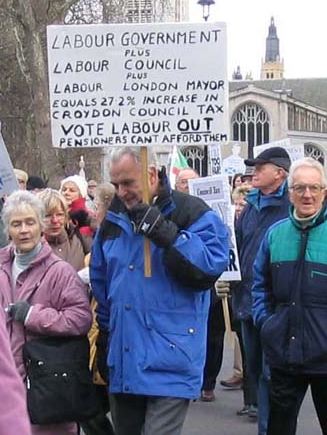


 Like many modern poets and artists, this ex-con's work is conspicuous only for meeting standards attainable by anyone able to make a random mess of words (or paint) and speak in woolly terms about what it signifies. Of course, it isn't Mr Zephaniah's fault that the liberal establishment is so wary of merit and ability that it is ever-conscious to reward its absence. What he can be held responsible for is a disgraceful reflexive anti-imperialism and a spouting of history apparently learned more from Hollywood blockbusters than any serious accounts of the past. Britain did not introduce slavery to Africa, but she did bring it to an end there. In so ungratefully rejecting the OBE he was so undeservedly proffered, Benjamin Zephaniah seemed to endorse the exact opposite theory, before complaining that Tony Blair was threatening to privatise everyone. Apparently Zephaniah is so terrified of privatisation that he has convinced himself not only that he would prefer to be taken into public ownership, but that he already has been.
 If this creepy-looking man doesn't symbolise the wonders of our liberal elite, I don't know quite who does. A very late entry, he managed to knocked Tessa 'Christmas is for Hindus and Muslims, but not Christians!' Jowell off the list completely. How? Well, he got involved in an interesting experience in democracy run by the BBC's Today programme. Any listener was invited to suggest a law that they would most like to see passed. Listeners were invited to vote on their favourite, and when it was chosen, Stephen Pound promised to use his influence to try to get it passed as a private members' bill. If it had sufficient parliamentary support, it would therefore become law. Not a bad idea, eh? Ordinary people would get some input into the law-making process, while parliament, which would ultimately decide whether the law was passed, would have its sovereignty retained.
 This vigorous opponent of marriage has also been a phenomenal opponent of British business, carrying on the New Labour tradition of ensuring that many small businesses are little more than government bureaucrats and tax-collectors, turning up to work every day only to fill in forms and hand over their profits. The brave Ruth Lea of the Institute of Directors waged a brave campaign on behalf of those trying to get by in such a climate, and really showed signs of making an impact, appearing on television regularly to lambast Labour for its appalling anti-business record (only five of more than 400 Labour MPs have any business experience). Ruth Lea was sacked from the job she was performing so well this year, and I am told by those in a position to know that the one who fired her was aided very handsomely in a way only governments can help people shortly afterwards, and that this is no coincidence. I certainly wouldn't put it past the people who brought you the scandals of Ecclestone, Lobbygate, Mittalgate, Mandelson (twice), Rose Addis, Jo Moore, the Paddington survivors, Dr Kelly and the Hindujas. Rather than admit they are wrong and work ease the pain of their own folly, people like Hewitt will go to almost any lengths.
 Hattersley is conspicuous for his mediocrity in everything he has done.* His Guardian columns are generally tiresome and dull "Attlee was right" screeds. His works of political philosophy were widely derided (he sent the first draft of one book to the liberal philosopher John Rawls for advice, only to be counselled to start it again from scratch). His Keynesian price controls when Minister for Prices and Incomes in the 1974-79 government provoked the Winter of Discontent. He ran in the 1983 Labour leadership election and lost to Neil Kinnock, who with two General Election defeats to his name stands out as probably the greatest political failure of modern times. Nonetheless, Hattersley was so impressed he later welcomed his own defeat, saying that Kinnock was a better leader than he could have been. For once, he may be right. He went on as Deputy Leader, standing right behind the aforementioned failed leadership for nine long years.
 A rather weird lizard-collector, this otherwise non-descript man is hardly bursting with achievements to his name. He has himself recognised this, and chosen to blame the people who created the Mayoralty for giving it no real power for him to exercise. Maybe so. But I would still nominate one clear front-runner as his most substantial achievement. That is Red Ken's success in portraying himself as a noble warrior fighting for the people ever since the GLC was scrapped for its incompetence and undemocratic actions in 1986. It's obvious that most of the people who buy into this myth actually believe Ken Livingstone was elected. In fact, his rise to the top of the Greater London Council was one of the most shameful and digusting acts of contempt for the voters in recent decades. Just sixteen hours after a new Labour council was elected, with Andrew McIntosh at its head, Livingstone organised his supporters - a gang of Marxists, militants, sexual 'liberationists' and IRA supporters - and removed McIntosh from power, ensuring Londoners woke up to his new style of reign. One doesn't want to go too far into his dodgy dealings in the 1980s, from his use of taxpayers' money to fund extremist groups with names like 'Babies Against the Bomb' and 'Sinn Fein Lesbians for Peace' to his talks with the IRA while they were bombing Londoners, but it is important to recognise that the scrapping of his GLC was about protecting Londoners from the arbitrary power of a man only 5% of them had heard of the night he lead a coup that put him in charge of London. His portrayal of himself as a brave defender of democracy is absurd.
 Another one to attend that march was the Liberal Democrat leader. "Picture it." Kennedy once wrote in reference to a future campaign against the euro. "Margaret Thatcher, Tony Benn, Norman Tebbit and William Hague, perhaps even Ian Paisley, together at a press launch". Well so far we haven't seen such a press launch. What we have seen is Charles Kennedy, Tony Benn, George Galloway and Tariq Ali addressing communists, Islamofascists and silly students on a march jointly organised by the aforementioned Muslim Association of Britain and the Stop the War Coalition, which is led by Andrew Murray, a supporter of North Korea who celebrates Stalin's birthday. It is difficult to underestimate the chorus of execration that would greet any Tory leader who joined a march organised by the BNP. But it is safe to say that no excuse offered would be acceptable. If the press took a consistent attitude to communist and fascist extremism, Kennedy would not be Lib Dem leader today.


